The Climate and Environmental Legacy of Governor Janet Mills
Introduction
When Janet Mills took office in January 2019, Maine was emerging from eight years of an administration that actively derided safeguards for the environment and ignored the impact climate change was having on the state. People in Maine were left behind, forced to defend protections for air, land, water and wildlife, while other states embraced new technology and forward-looking solutions.
Governor Mills appointed highly qualified individuals to her Administration and staff, who recognize the value of Maine’s natural resources to the people of Maine and the critical importance of reducing our dependence on fossil fuels. Over the past eight years, the Mills Administration has fundamentally changed the state’s trajectory, leading to healthier communities, less pollution, and new economic development in a growing clean energy sector. She made climate action a central priority of her administration, positioned Maine as a national leader in renewable energy and climate resilience policy, reduced carbon pollution, and oversaw one of the most productive periods for progress on climate solutions in state history.
Over the past eight years, the Mills Administration has fundamentally changed the state’s trajectory, leading to healthier communities, less pollution, and new economic development in a growing clean energy sector.
The accomplishments we highlight here tell only a small part of that story. During her tenure, the Mills Administration advanced Maine’s renewable energy industry from niche rooftop solar arrays to a major source of electricity generation, made significant progress toward developing a floating offshore wind port, defended democratic institutions and the rule of law in the face of repeated attacks by President Donald Trump, and strengthened Maine’s voice on the national and international stage as a climate leader. She also governed through the COVID-19 pandemic, demonstrating tremendous endurance and leadership during an unprecedented public health crisis that forced difficult decisions about health care, personal liberty, economic stability, and the continuity of government.
No governor leaves office with a perfect record, and Gov. Mills is no exception. Her resistance to self-determination for the Wabanaki Nations remains a profound disappointment. There were moments when her administration could have shown greater ambition on conservation, environmental justice, and supporting the development of good paying union jobs that can deliver both economic prosperity and the clean energy transition. She vetoed a data center moratorium bill because it didn’t contain a carveout for a project proposed in Jay, all for the developer to cancel the project a few weeks later.
Yet viewed as a whole, her record represents a significant period in Maine history of environmental and climate progress. This retrospective examines that legacy—celebrating remarkable accomplishments, acknowledging important shortcomings, and considering the foundation it leaves for the next generation of leaders.
Unlike her predecessor, Gov. Mills understands the threat climate change poses and took decisive action to make Maine a cleaner, safer state from the moment she entered office. She established the Maine Climate Council her first year in office when she signed LD 1679, An Act to Promote Clean Energy Jobs and to Establish the Maine Climate Council. The legislation declared climate change an emergency and set new carbon pollution reduction targets. The thirty-nine member council released its first Climate Action Plan, Maine Won’t Wait, a year later in 2020 and has released an annual update every year since, including a major four-year update in 2024. Under the Mills Administration’s leadership, the Council’s work has been implemented through dozens of pieces of legislation, executive orders, budget allocations, and state agency actions, leading to reduced energy costs for Maine people, cleaner air, and a healthier climate.
Chief among Gov. Mills’s climate accomplishments was the establishment of bold climate goals.
Chief among Gov. Mills’s climate accomplishments was the establishment of bold climate goals. Gov. Mills and the state legislature set binding targets to achieve statewide carbon neutrality by 2045; reduce greenhouse gas emissions 80% by 2050 compared to 1990 levels; and power Maine’s grid with 100% clean energy by 2040, accelerating a previous Mills Administration goal by a full decade. Goals like these are critical to a stable climate future and will lead to fewer extreme weather events, decrease the rate by which global air and sea surface temperatures rise, and help protect vulnerable ecosystems.
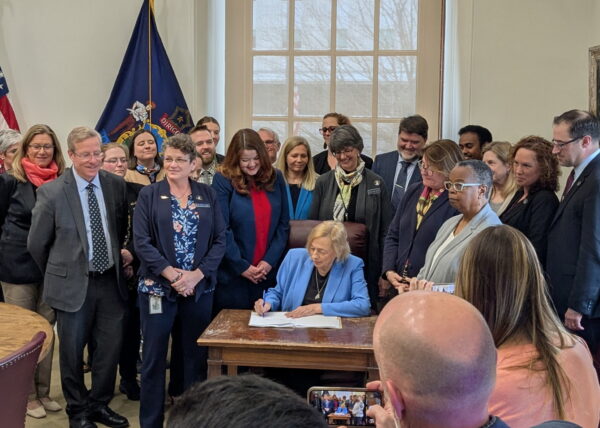
She also reestablished Maine as a climate leader. Doing so was crucial after Gov. LePage’s inaction and President Trump’s withdrawal of the United States from the Paris Climate Accords in 2017. Upon taking office in 2019, Gov. Mills committed Maine to meeting the goals of the Paris Accords, joined the U.S. Climate Alliance, and became the first sitting Maine governor to address the United Nations General Assembly. Gov. Mills went on to be elected co-chair of the U.S. Climate Alliance in 2023 alongside Washington Governor Jay Inslee. In 2026, Maine renewed its spot in the Regional Greenhouse Gas Initiative (RGGI), a northeast regional carbon cap and trade program, committing to participation through 2037.
A robust offshore wind industry offers the best opportunity for Maine to meet its climate goals, reduce energy costs, and create new, family-sustaining jobs. Gov. Mills recognized this opportunity, and her administration has worked diligently to give life to the industry, most notably through the passage of LD 1895, An Act Regarding the Procurement of Energy from Offshore Wind Resources, in 2023.
This law was the result of productive collaboration among environmental groups, organized labor, fisheries stakeholders, legislative champions, and the Mills Administration and is a significant clean energy achievement. It sets a schedule for the development of 3 GW of installed offshore wind energy by 2040, establishes strong labor standards for the installation of wind turbines and the construction of a world-class offshore wind port in Maine, and creates a framework for fairly and expeditiously permitting offshore wind port infrastructure. Importantly, it also creates balance among competing ocean uses by incentivizing development outside of Lobster Management Area 1, a priority fishing ground for fisheries stakeholders; requiring fisheries, environmental, and wildlife research, monitoring, and mitigation; and establishing consultation requirements for the State with each of the Wabanaki Nations.
In addition to supporting new, large, clean energy sources, Gov. Mills recognized early that one of Maine’s biggest climate and energy challenges was its heavy dependence on heating oil, more than any other state. In 2019, Gov. Mills signed LD 1766, An Act To Transform Maine’s Heat Pump Market To Advance Economic Security and Climate Objectives, establishing a goal of installing 100,000 heat pumps statewide by 2025. Maine exceeded that goal two years ahead of schedule, becoming a national leader in heat pump deployment. In response, the Mills Administration raised the bar, setting a new target of installing an additional 175,000 heat pumps by 2027. The administration also established a goal of installing at least 40,000 heat pumps in low-income households, helping ensure that the benefits of lower energy costs reached those who need them most.
A robust offshore wind industry offers the best opportunity for Maine to meet its climate goals, reduce energy costs, and create new, family-sustaining jobs.
The Mills Administration paired these ambitious goals with sustained investments in energy efficiency through Efficiency Maine Trust. Expanded rebates for heat pumps, weatherization, high-efficiency appliances, and other energy-saving upgrades helped promote beneficial electrification, lower household energy costs, reduce carbon pollution, and support clean energy jobs across the state. Paired with investments in workforce development to train electricians, HVAC technicians, and other skilled workers, these efforts made efficiency and electrification a cornerstone of Maine’s climate strategy and delivered practical savings for Maine households while tackling one of the state’s most challenging sources of climate pollution.
In the year 2000, five weather-related disasters caused over a billion dollars in damage in the U.S. Last year, there were twenty-three. Between March of 2022 and May of 2024, Maine experienced nine natural disasters, each devastating enough to merit Presidential Major Disaster or emergency declarations. Even the most ambitious climate action cannot prevent the impacts of a warming world. As Maine experiences more severe storms, flooding, coastal erosion, and other climate-related disasters, the need to invest in resilience and adaptation has become increasingly clear.
Between March of 2022 and May of 2024, Maine experienced nine natural disasters, each devastating enough to merit Presidential Major Disaster or emergency declarations.
One of the administration’s most significant accomplishments was creating the Community Resilience Partnership (CRP), a first-in-the-nation program that provides municipalities and Tribal governments with technical assistance, planning support, and grant funding to reduce emissions and prepare for climate impacts. Since its launch in 2021, the Partnership has grown to include more than 260 communities—representing roughly three-quarters of Maine’s population—and has awarded more than $15 million in grants supporting hundreds of local climate, energy, and resilience projects across all sixteen counties. Through the program, communities have conducted vulnerability assessments, improved emergency preparedness, invested in energy efficiency, and undertaken projects to better withstand flooding, extreme weather, and other climate threats.
 Following the devastating storms of 2023 and 2024, Gov. Mills convened the Infrastructure Rebuilding and Resilience Commission, bringing together state and local leaders to develop recommendations for rebuilding stronger and preparing for future disasters. Those recommendations helped shape the bipartisan LD 1, An Act to Increase Storm Preparedness for Maine’s Communities, Homes and Infrastructure (2025), which made major investments in rebuilding damaged infrastructure and improving the resilience of roads, bridges, working waterfronts, and other critical assets. The administration also established the Maine Office of Community Affairs (MOCA) as a centralized hub to help municipalities navigate state programs, technical assistance, and funding opportunities. Within MOCA, the creation of the State Resilience Office institutionalized resilience planning across state government and provided communities with a dedicated partner for implementing adaptation and preparedness strategies.
Gov. Mills also recognized that resilience requires sustainable funding. As Maine faces growing costs from climate-driven disasters, she laid the groundwork for the state to establish a Climate Superfund by signing legislation to quantify the costs that climate change has imposed on Maine since 1995. That analysis is a critical first step toward holding the world’s largest oil and gas corporations accountable for the damages associated with climate change and ensuring that Maine communities have the resources needed to recover from and prepare for future climate impacts.
While climate and energy accomplishments often received greater attention, the Mills Administration also made meaningful investments in conserving the natural resources that support Maine’s communities, outdoor recreation economy, and traditional industries. Perhaps most significantly, Gov. Mills helped restore investment in the Land for Maine’s Future (LMF) program, the state’s flagship land conservation initiative. In 2021, she signed a budget that included $40 million for LMF, the program’s first major infusion of state funding in nearly a decade. The funding helped support the conservation of working forests, farms, waterfronts, wildlife habitat, and recreational lands across the state.
The administration also supported creation of the Land for Maine’s Future Trust Fund and, in her final year in office, Gov. Mills signed legislation establishing a dedicated revenue stream for the program, reducing its historic reliance on periodic bond campaigns. Together, these actions put Maine’s premier conservation program on more stable financial footing than it’s enjoyed in years.
Lack of funding for state agencies has been a perennial problem, however, and we wish that Gov. Mills would have been more willing to embrace new sources of revenue to make needed investments in state agency programs and staffing, including making sure that agency staff are paid living wages.
Land conservation is one of the most basic steps we can take to protect biodiversity and tackle climate change, and that’s why the Maine Climate Council also made it a pillar of Maine Won’t Wait, adopting a goal of conserving 30 percent of the state’s land by 2030. Roughly one-fifth of land in Maine is already conserved and more than 90 percent is privately owned. As a result, Maine’s approach to this goal has focused on voluntary conservation easements and working forests, farms, and habitat protection rather than large-scale public land acquisition.
The state has made slow and steady progress, reaching roughly 22.5 percent conserved land by 2025, but is far behind the 30 percent target. Achieving the goal is important, both symbolically and for the tangible climate and conservation benefits, and will require sustained investments in LMF, additional federal and private conservation funding, and continued collaboration with landowners and conservation organizations.
To support Maine’s outdoor recreation economy, the Governor in 2021 included $50 million for infrastructure and facility improvements at Maine State Parks, which experienced record-setting visitations during the pandemic. This was the largest infusion of sorely needed funding to address a backlog in maintenance needs at State Parks in decades.
Despite these efforts, overlapping crises in public health, housing affordability, workforce shortages, and economic development, often overshadowed progress on land and water conservation. Even so, the Mills Administration leaves behind a record of meaningful conservation progress that we hope her successor builds on.
Maine has been at the epicenter of the nation’s PFAS crisis. The problem was made worse here in part by a state-run program dating back to the 1980s that promoted the use of sludge–a byproduct from paper mills and wastewater plants–as an agricultural fertilizer. Decades of spreading PFAS-contaminated sludge on farmland left farms, private wells, and drinking water supplies contaminated with “forever chemicals” linked to cancer and other serious health impacts. Starting in 2016, regulators began finding alarmingly high levels of PFAS near dairy farms that participated in the program. In 2019, Gov. Mills created a PFAS task force by executive order to recommend solutions to the problem.
Over the next several years, Gov. Mills signed legislation banning the land application of sewage sludge on farmland (LD 1911), one of the most consequential PFAS laws enacted anywhere in the country, along with numerous other measures addressing firefighting foam, bottled water testing, and PFAS in drinking water. At the same time, Gov. Mills frustrated many by declining to sign the most ambitious proposals. She allowed landmark legislation, LD 1503, that banned PFAS in consumer products—a first-in-the-nation law that has since become a model for other states—to become law without her signature. She likewise declined to sign a bill, LD 1326, codifying Maine’s strengthened drinking water standards for PFAS.
Even so, by the end of her administration, Maine had built one of the strongest PFAS regulatory frameworks in the country. Future administrations have a solid foundation to continue protecting communities from these toxic forever chemicals, for example, by securing additional resources for testing and remediation and setting industrial discharge limits.
No assessment of Gov. Mills would be complete without acknowledging her unwillingness to recognize fully the inherent sovereignty of the Wabanaki Nations—the Houlton Band of Maliseet Indians, the Mi’kmaq Nation, the Passamaquoddy Tribe, and the Penobscot Nation. While Gov. Mills signed a number of important tribal bills—including the Mi’kmaq Nation Restoration Act and the Maine Indian Child Welfare Act—her administration consistently resisted broader efforts to modernize the 1980 Maine Indian Claims Settlement Act and its accompanying state counterpart, the Maine Implementing Act (collectively known as the Settlement Acts). These actions denied the Wabanaki Nations a sovereign status enjoyed by nearly every other federally recognized tribe in the United States.
Tribal sovereignty is not separate from conservation and climate action. MCV supports self determination for the Wabanaki Nations because the health of the land, water, and wildlife in Maine is inseparable from the rights of the Indigenous peoples who have cared for them for generations. Gov. Mills’ reluctance to embrace meaningful reform ultimately placed her at odds with one of the state’s most important opportunities to correct a historic injustice. As a result, her record on tribal relations remains a significant failure on an otherwise strong environmental and climate legacy.
The clearest examples were her opposition to LD 1626 in 2022 and her veto of LD 2004 in 2023, both bipartisan measures that sought to restore the Wabanaki Nations’ access to federal laws and programs generally available to other tribes. These efforts emerged from work by the bipartisan Task Force on Changes to the Maine Indian Claims Settlement Implementing Act and won substantial support in the Legislature and from tribal communities, the broader public, legal scholars, and environmental organizations.
MCV supports self determination for the Wabanaki Nations because the health of the land, water, and wildlife in Maine is inseparable from the rights of the Indigenous peoples who have cared for them for generations.
Yet the administration repeatedly argued that tribal rights should be addressed incrementally rather than through comprehensive reform. Under this framework, the Wabanaki Nations still successfully fought for and Gov. Mills signed legislation including: the Mi’kmaq Nation Restoration Act, which placed the tribe on equal footing with the Passamaquoddy Tribe and Penobscot Nation under state law; the Maine Indian Child Welfare Act, which codified important federal changes designed to keep Wabanaki children connected to their families and culture; expanded tribal authority over criminal matters on tribal lands (LD 2007, 2024); internet gaming opportunities (LD 585, 2022); additional resources for the teaching of Wabanaki studies in schools (LD 1474, 2026); and the ability for the Passamaquoddy Tribe at Sipayik to regulate their own drinking water (LD 906, 2022).
This helter-skelter approach to legislating tribal affairs demonstrates the glaring flaws with the Settlement Acts that have long made the Wabanaki Nations an exception within federal Indian law. Sovereignty is absolute and universal–and it is fundamentally denied when every right, freedom, and permission is painstakingly negotiated one by one.
Governor Janet Mills will leave office having contributed in measurable and important ways to the conservation of Maine’s environment through climate action and natural resource protection. She demonstrated that ambitious climate action, clean energy deployment, conservation, and community resilience are not competing priorities but complementary investments in a healthier, more prosperous state. Despite her administration’s shortcomings regarding Wabanaki sovereignty, Gov. Mills has been a strong climate and environmental governor. The challenge for her successor will not simply be to preserve that legacy, but to build upon it with the same urgency.
Chronology

Signs into law LD 1766 to install 100k heat pumps in Maine households by 2025
to declare climate change an emergency and set new climate goals
Gov. Mills creates PFAS taskforce by Executive Order

Declares Civil State of Emergency for COVID-19 pandemic
Maine Won't Wait, to reduce energy costs for Maine people and promote cleaner air and a healthier climate
a first-in-the-nation program to support municipalities and Tribal governments with emissions reductions and prepare for climate impacts.
with $40 million investment

to prevent further PFAS contamination
creating service opportunities for Mainers to help achieve the goals outlined in Maine Won’t Wait.
to set a schedule for 3 GW of offshore wind by 2040
beating original goal by 2 years
denying the Wabanaki Nations and surrounding communities access to federal beneficial laws for federally recognized tribes
to help municipalities navigate opportunities for climate resilience and adaptation.

Gov. Mills decarbonizes state-owned buildings and establishes the Infrastructure Rebuilding and Resilience Commission

LD 1868 commits Maine to 100% clean electricity by 2040
to rebuild damaged infrastructure and improve the resilience of roads, bridges, and working waterfronts.
to calculate the financial cost of climate change to Maine and lay the groundwork for a Climate Superfund
blocking a pause on large-scale data centers, and creates the Maine Data Center Advisory Council by Executive Order
for the first time in program’s history